
Columbus Day fun
 Category Beer
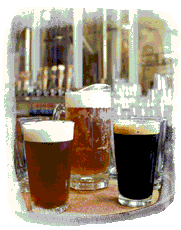
Well, I'm brewing today. It's been a LONG time since I've brewed, and I've really missed it. Soaking grains in a sparging bag while s-l-o-w-l-y adding heat to the kettle, watching & fretting over it as it darkens, the timing of adding malts & hops and removing the sparge, cooking & stirring the wort, then cooling it and pitching the yeast; these are things that I truly enjoy.
As with cooking, brewing is something that I do primarily for the enjoyment of the work; not necessarily for the end product. Don't get me wrong, I very much enjoy my beer (as have many of you); but I think I like making it even more than I like drinking it. As my brewing skills get better (practice makes perfect), I have noticed that I'm more concerned with making truly great beer than with simply making beer.
The best way I can describe this difference is that it is similar to omelettes. I know, you are wondering just what the heck a beverage made from water, barley, hops, & yeast can possibly have in common with an egg dish, but hear me out.
I sort of like omelettes. I've been known to occasionally order them in restaurants; and I've enviably disappointed in them. Why have I been disappointed? Because there is a big difference between "scrambled eggs & cheese" and omelette. If you don't believe me, go to a really good French restaurant (something like Jeanty at Jack's in San Francisco, Daniel in New York, or L'Espalier in Boston) and order one. Don't worry if it's not on the menu. Tell the server that you would like the chef to make you a "traditional omelette", and just wait. The chef will know exactly what you are asking for.
A properly made omelette is light, smooth, & delicious. The two eggs are beaten until they form a custard, and are cooked in a......you know what, I'm not going to tell you any more on this. You'll just have to trust me and order one yourself, or go to Le Courdon Bleu and learn how to make one. The point is, a properly made omelette has about as much in common with the "scrambled eggs & cheese" you get at Denny's as a bucket of warm beer.
Ahh beer. As when I'm cooking omelettes; I enjoy the process more than the end product. I've been told that my beer is incredibly good (as are my omelettes); I think this is because focus so intently on doing it right. I really enjoy brewing (and cooking omelettes), it is soothing to me, almost to the point of being therapeutic. I'm generally very happy & content after brewing or cooking (especially for others). Like I said, it's not so much the end product as it is the "creation process".
What does this have to do with Columbus day? Well, not a whole lot. Although some of you might be interested to learn that when Columbus came to the New World, he found the natives already knew how to make beer. Granted, they didn't use water, barley & hops (the Reinheitsgebot wouldn't be adopted for another 24 years, and even then wouldn't apply to them, geography being what it is). They (the natives) made their beer from a mash of corn and black birch sap. Yummy.
Oh, and by the way, for all of you morons nice folk who believe and continue to spew the malarkey that Columbus thought he was in India when he landed, and that's why he called the natives here "Indians"; please shut the heck up and grow a brain. Columbus was a great navigator. He had a pretty good idea about how big the world was (is); he just didn't know what was between Europe and Asia. He most certainly knew he was no where near India when he landed.
"So why did he call them Indians, if he didn't think he was in India?" some of you are now asking. He didn't.
When referring to the natives, he interchanged two different terms: in Deus, and Deus sans. For those of you who never studied Latin, both of these have roughly the same meaning: "without God". Remember, he was doing more than just searching for a quick trade route to India. He was also trying to (in his own way) to spread the word. Historians (or lazy teachers, or poor writers; I'm not quite sure which) merged these to produce the term Indeusans, which over time came morphed into "Indians".
Blame poor teaching, poor grammar, lazy speaking habits, or whatever you want for the term; but please don't continue to propagate the BS that Columbus thought he was in India. Our kids have it hard enough as it is without us deliberately teaching them crap.
Hope you have a nice day, I'm gonna go fire up the kettles now...
-Devin


 The Pridelands
 Chris Byrne
 Show n' Tell Thursdays
 Maddox


Comments
Seriously, I do like a good omelette, but they are hard to come by.
Posted by Ben Langhinrichs At 11:49:24 AM On 10/10/2005 | - Website - |
Ben, you have it all wrong. Mugs are for FLOATS, not milkshakes. Milkshakes are best served in a parfait glass, with the extra in the metal mixing cup on the side. (Oh sweet milksake, how you tempt me with your creamy goodness......
-Devin
Posted by Devin Olson At 12:50:55 AM On 10/11/2005 | - Website - |
Posted by Ben Langhinrichs At 11:34:02 AM On 10/11/2005 | - Website - |
You know I'm a proponent of the truth, but the truth must have reliable sourcing.
I'll need to see some primary sources to prove your comments........I'm a pretty good historian, and have never read anything to back your claim up.
I'm open to anything, so please enlighten me on this matter.
Posted by poison_pero@myway.com At 12:10:58 PM On 10/12/2005 | - Website - |
While the fact that 3 different teachers at 3 different high schools might not be enough to give credence to the story; I should point out that Alta High School is in Sandy, Utah; Cortez High School is in Phoenix, Arizona and Apollo High School is in Glendale, Arizona.
While this is still technically hearsay (as I don't have any written documentation to back this up), I'm willing to put more than just "faith" in is as the truth; for several reasons.
1) I heard essentially the same story from 3 different people, in 3 different locations, over a period of 4 years.
2) Each of these people would have been (by virtue of their position and work history) in an educational "situation" such that they should have had some documentation. Meaning even though I don't have any written documentation, I'm fairly sure they would have had it. Particularly Mr. Fish, who was, as I stated, my Latin teacher.
3) It (the story) holds the "ring of truth". It takes a greater stretch of the imagination to hold to the belief that one of the greatest navigators of the time would "miss the mark" by 11 thousand miles.
It is a historical fact that he was searching for a trade route to India. From that we can extrapolate that he knew where India was. From that extrapolation, we can further extrapolate that he probably knew he wasn't there. I maintain that the currently-taught tale of him thinking he was in India and therefore calling the natives he met "Indians" not only stretches credulity to the breaking point, it also builds the case that he was an absolute idiot; which he clearly was not.
I wish I had more to go on than this, but sadly, that is all I have. However, just as a "back at ya", I wonder what valid documentation (other than hearsay) exists that backs up the "thought he was in India" theory?
-Devin.
Posted by Devin Olson At 11:17:14 PM On 10/12/2005 | - Website - |
https://www.henry-davis.com/MAPS/LMwebpages/256.html
There are other resources from the period, most of which show the same sort of distortion of distance -- Europe is mostly to scale, northern Africa is narrower than it should be, and the Indian Ocean is nearly Pacific-sized. (Other distortions, such as non-existent land bridges, are clearly just supposition on the cartographers' part.)
I have no doubt that there was literature that gave an alternate explanation for the term "Indian". For some reason, we have a tendancy to oscillate back and forth between building our heroes up and knocking them down. There was a period when it was fashionable to think of Columbus as a bumbling, pretentious fool who "pulled a Homer", discovering a whole new world while believing himself to be thousands of miles from where he actually was. If that was not true, then he must have meant something quite different when he used the term "indios", and a back-formation from his description of the people as heathens would have slipped through with little scrutiny at the time. It is, however, entirely possible for Columbus to have known more-or-less how far he had gone and still believe himself to have been in the Indies.
Posted by Stan Rogers At 05:05:50 PM On 10/15/2005 | - Website - |